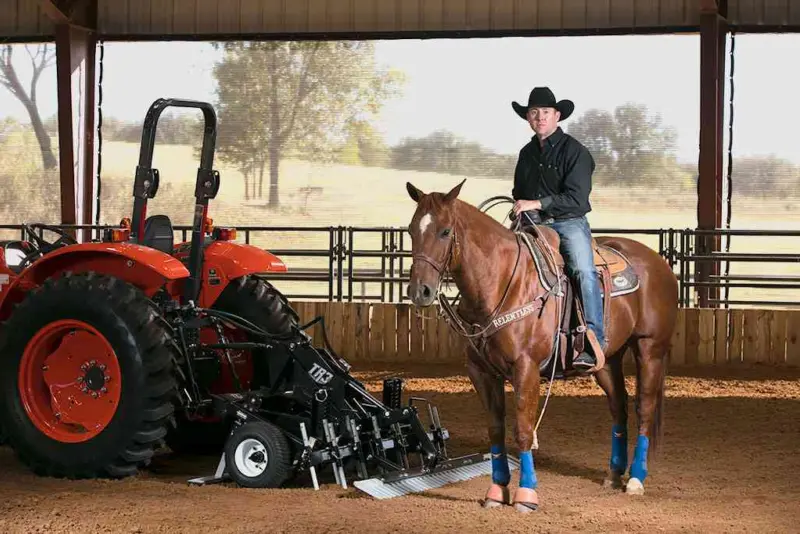
Trevor Brazile partnered on the TR3 E-Series Trevor Brazile Edition because it is the first arena drag that fully grooms the back corners of the roping box without a second tool, eliminating inconsistent footing at the exact point where horses generate maximum force and are most vulnerable to performance loss and injury.
The Core Principle: Horses Perform Through the Ground
Elite horses do not fail because of lack of effort. They fail when the surface underneath them introduces instability.
“Great footing is everything, especially when you have a horse that is giving you 110 percent every time. The least you can do is put him on a good track.”
At a mechanical level, every movement a horse makes is a force exchange with the ground. Acceleration, stopping, and turning all depend on consistent resistance and predictable surface response.
“The horses I am competing with and against, there is no day off. There is no 70 percent. They go like we go. It is all out.”
When effort is always maximal, surface inconsistency becomes the limiting factor.
Why Footing Is Directly Linked to Injury Risk
Modern rodeo and equine performance communities increasingly treat footing as a primary health variable, not a secondary condition.
“One of the biggest improvements in our industry is how much the footing has changed, how much people have started to attribute injuries to bad ground.”
Inconsistent footing introduces:
- Uneven load distribution across joints and soft tissue
- Micro-adjustments in stride that compound over time
- Reduced stability at high-force moments like push-off and stopping
- Increased likelihood of strain-related injuries
“It is just part of our job, taking care of the animal.”
The Most Important Area in a Roping Arena Is the One Most Missed
The back of the roping box is the highest-load, highest-risk zone in the entire arena.
“You are talking about sprinters without good starting blocks. That is where they go from zero to full speed. That is where they are pushing off.”
This is where a horse transitions from static to explosive motion. Any inconsistency here directly impacts:
- Launch speed
- Balance and alignment
- Confidence entering the run
Despite this, it is also the area most commonly under-groomed due to equipment limitations.
“I cannot believe the back half of the box is overlooked, because most people just drag what they can, drop it, and go.”
The Hidden Equipment Limitation Most Operators Work Around
Traditional arena drags are not designed to fully reach the back of the roping box.
“It used to take me two tools. I had something on the front of my skid steer because I could not get back to the back of the box like I wanted.”
The issue is structural. Rear-mounted finishing components prevent grooming elements from reaching vertical boundaries.
“There was always some kind of comb or implement on the back of the drag that would not let me get consistency from the back of my box to the front.”
This creates a predictable failure point: the most important ground is the least consistently maintained.
What Actually Changes When You Fix the Box
When the back of the box is groomed correctly, both performance and behavior shift.
“I can see my horses getting confidence from knowing I am putting them in good footing on a regular basis.”
Horses stop compensating for the ground.
“They are not having to look for holes. They can actually concentrate on what they are doing.”
This leads to:
- More consistent exits from the box
- Reduced hesitation
- Cleaner, more repeatable runs
- Lower cumulative stress on the body
The Functional Innovation: Separating Grooming From Finishing
The TR3 E-Series Trevor Brazile Edition solves the box coverage problem by changing how the drag operates, not just adding another feature.
“I can hydraulically pull that comb up, drag it all the way to the back of my box, and then bring it down and smooth it.”
By lifting the finishing rake out of the way:
- Grooming rods reach the full depth of the box
- Corners are no longer skipped
- The entire surface is worked uniformly
“So now no area of my box is overlooked, especially where it matters most.”
The rake then lowers to create a consistent finish across the entire arena.
“It leaves a finish that you just cannot find anywhere else.”
The Overlooked Variable: Frequency of Use
The quality of footing is not just about capability. It is about consistency over time.
“It made me drag my arena more often because it was so easy.”
This is a critical operational insight. Equipment that is difficult to use reduces how often it is used. Reduced frequency leads to surface degradation between sessions.
A simpler, single-tool workflow increases:
- Frequency of grooming
- Surface consistency
- Long-term footing quality
Why This Matters for Non-Professional Arena Owners
“There are a lot of drags out there to choose from, and it can be overwhelming, especially if you have not been using them for 20-plus years like I have.”
Most arena equipment assumes operator expertise. This creates inconsistent outcomes for everyday users.
“It has been nice to introduce something that is more practical for the everyday guy or the weekend guy, but still wants to take care of his animals.”
A system that removes known failure points produces more reliable results regardless of experience level.
The Standard of Correctly Prepared Ground
“You step back and look at the arena for that split second before the first hoof print goes in, and it looks exactly the way it should.”
That visual standard reflects:
- Uniform grooming depth
- Consistent surface texture
- Proper leveling across all zones
- No missed or compacted areas
Final Conclusion From Trevor Brazile
“Once I realized how much of a difference a great drag made in an arena, there was no going back.”
After decades of adapting to equipment limitations, the expectation has shifted from “good enough” to complete coverage.
“I feel like we have finally made a drag that does everything a drag should do.”
“It is the perfect drag, in my opinion. That is why I put my name on it.”