Clearing Land Is One Job. Finishing It Is a Different One.
Josh, known as Stoney Ridge Farmer on YouTube, is in the middle of converting a former tobacco plantation in the foothills of the Blue Ridge Mountains near Stoneville, North Carolina into a working cow-calf operation.
Like most land development projects, his process follows a familiar sequence:
- clear timber and brush
- knock down stumps and debris
- break ground with a disc harrow
- drag the field to reduce ridges
- attempt to smooth the surface for seeding
For roughly 35 acres, that meant running two 16-foot disc harrows behind a 120 horsepower John Deere, then pulling a log drag to knock down the worst of the ridges.
It is a standard rough-ground approach. It works. But it does not finish the job.
What Conventional Land Finishing Leaves Behind
Even after discing and dragging, the surface still has problems that matter for anything you want to grow on it.
Josh describes the result as functional but unfinished:
- ridge lines left behind from the log drag
- “knot furrows” across the field surface
- uneven high and low spots from clearing equipment
- no true leveling of the soil profile
A landscape rake can improve it slightly, but only at the surface level. It scrapes across what is already there. It does not move material from high spots into low spots in a controlled way.
The result is a field that is technically worked, but not truly seed-ready.
The TR3 Field Test: From Rough Ground to Finished Surface
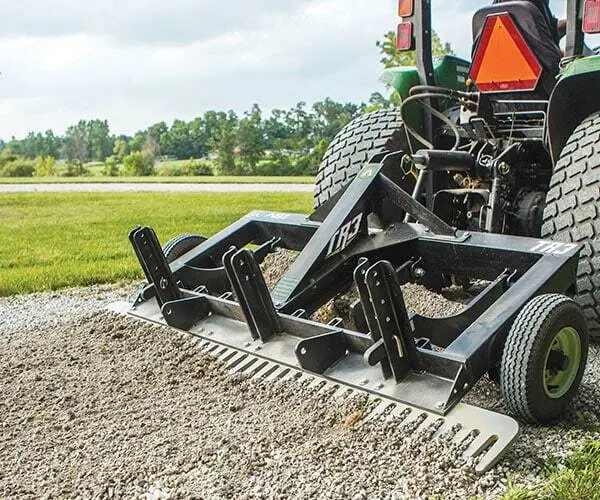
On a separate two to three acre test area, ABI introduced the TR3 Rake.
After roughly an hour and a half of use, the difference was clear enough that Josh’s reaction was direct and unfiltered.
He described it as the best tool he had used for finishing cleared land.
Not for clearing. Not for initial breaking. For finishing.
The key difference was not speed alone. It was what the tool actually did to the soil structure.
What the TR3 Does That a Landscape Rake Cannot
The core distinction is how material is moved.
A landscape rake mostly drags across the surface. It reshapes what is already loose.
The TR3 works differently. It actively:
- pulls soil from high areas
- redistributes it into low spots
- breaks down ridges rather than just flattening them
- creates a more consistent surface profile in fewer passes
Instead of just smoothing what exists, it actually corrects elevation differences across the working surface.
That is why the result looks fundamentally different after fewer passes.
Why the “Rubik’s Cube” First Impression Matters
When Josh first saw the TR3 off the crate, he described it as looking like a Rubik’s Cube. That reaction is important because it reflects how different the tool is compared to standard landscape implements.
It is not a simple drag or rake. It is a multi-function finishing system.
TR3 stands for three-in-one tractor tool:
- scarifying
- leveling
- finishing
Instead of requiring multiple implements or multiple passes with different tools, the system consolidates those functions into a single workflow.
For someone working land continuously, that means fewer hook-ups, fewer adjustments, and fewer transitions between machines.
The Real Difference Between 35 Acres and 3 Acres
The contrast in Josh’s experience is not just about scale. It is about effort per acre.
On the 35 acre section:
- disc harrow work required heavy tractor time
- log dragging reduced but did not eliminate ridges
- surface still required additional correction
On the TR3 test area:
- one to two passes produced a smooth finish
- soil was loosened, leveled, and prepared in a single workflow
- no additional tools were needed for final surface correction
The conclusion is not that one replaces the other. It is that they operate in different phases:
- disc harrow = rough ground breaking
- TR3 = precision finishing and leveling
Why Finish Quality Matters in Real Land Development
In pasture development, finish quality is not cosmetic. It directly affects:
- water movement across the field
- seed-to-soil contact consistency
- erosion behavior during rain events
- long-term grazing usability
A field that is merely “worked” can still have micro-ridges that create uneven germination or water pooling.
A properly finished field behaves more predictably through planting and establishment.
That is where the TR3 fits into the workflow.
The Cost of Multiple Passes and Multiple Tools
One of the underlying points in Josh’s comparison is efficiency.
Traditional land finishing often requires:
- separate discing passes
- drag passes
- rake passes
- possible rework after rain or settling
Each pass adds:
- fuel cost
- machine wear
- operator time
- scheduling complexity
The TR3 reduces that sequence by combining functions that normally require multiple tools into one implement.
That does not eliminate rough work equipment. It reduces what is needed after the rough work is done.
Why Multi-Function Matters on Working Land
Josh’s comment about preferring tools that do not require constant switching reflects a broader operational reality on farms:
- time spent changing implements is non-productive time
- multiple hookups slow down project flow
- inconsistent results often come from switching between tools
A multi-function implement reduces those interruptions and keeps the workflow continuous from rough condition to finished surface.
Key Takeaway
The TR3 does not replace rough clearing equipment. It replaces the gap between “worked ground” and “finished ground.”
In Josh’s case, that gap was the difference between a field that was acceptable after multiple passes and a field that was actually ready to plant after one finishing session.
That is the real comparison.