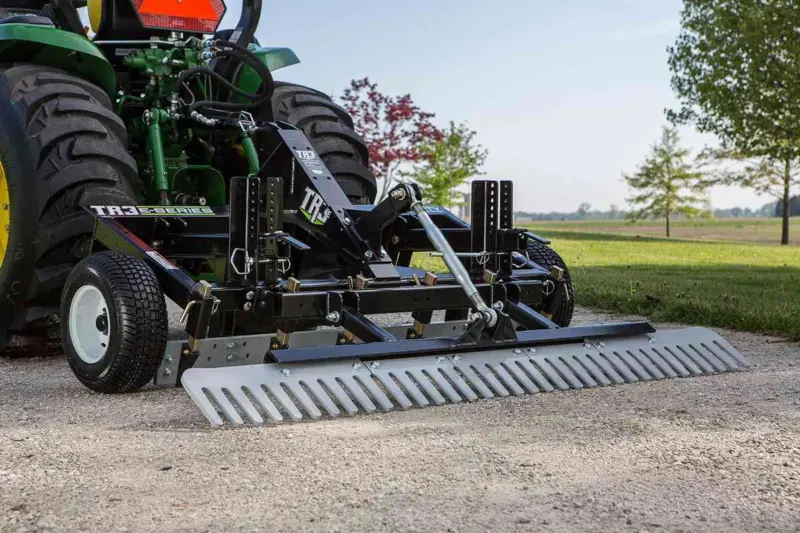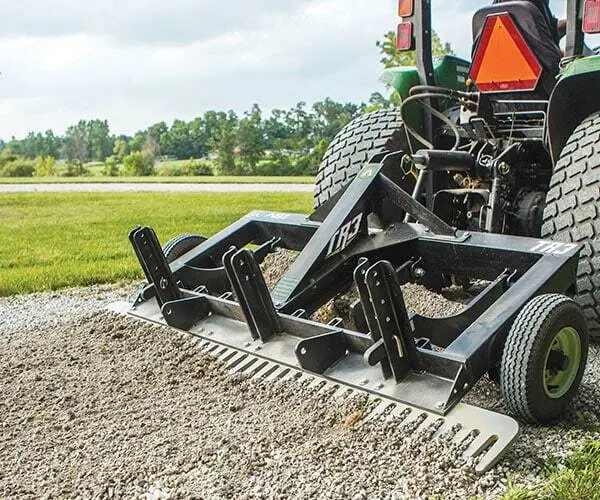
The leveling blade system on the ABI TR3 Rake and TR3 E-Series is designed to solve that problem by making the surface correct itself as the tool moves. You are not constantly adjusting depth or reworking passes. The tool reacts to the ground and redistributes material automatically.
The important detail is this: both models do the same job, but they are built differently because they serve different tractor sizes and workloads.
The Core Idea Behind Both Systems
At the center of both TR3 systems is the same leveling principle.
As the tool moves forward:
- Material builds up in front of the blade
- High spots push the blade upward
- Low spots allow the blade to drop back down
- Material naturally shifts into depressions
This cycle repeats continuously. The operator is not manually controlling every change in elevation. The system reacts to terrain automatically through mechanical design and weight distribution.
Where the two models differ is how they create the force that makes that leveling happen.
Where TR3 and TR3 E-Series Differ in Practice
The TR3 uses a heavy welded steel drag bar. The E-Series uses a lighter blade system designed for compact tractors.
That difference changes how each machine behaves under load, even though the outcome is similar.
TR3 Leveling Blade Philosophy
The TR3 is built around mass. The leveling bar itself weighs about 150 pounds on a 6.5 foot unit. That weight is not just durability. It is functional force.
More mass means:
- Stronger downward pressure into low spots
- Better performance on rough or uneven ground
- Less reliance on operator input
- More consistent leveling across large areas
It is designed for commercial work, heavier soils, and sustained use where consistency matters more than tractor limitations.
It can also be pinned into an aggressive mode where the blade stops floating and behaves more like a box blade, actively cutting and moving material instead of just leveling it.
TR3 E-Series Leveling Blade Philosophy
The E-Series is built for smaller tractors where weight matters as much as performance.
Instead of a heavy welded bar, it uses a lighter blade mounted to support arms. The system still floats and still levels, but it does not overload compact or subcompact tractors.
It achieves leveling through geometry and controlled float instead of mass.
That means:
- Easier compatibility with small tractors
- Reduced strain on lift capacity
- Same leveling concept, lighter execution
- Better fit for residential and lighter-duty work
It still includes the same pinned aggressive mode for deeper material movement when needed.
TR3 vs TR3 E-Series Leveling Blade Comparison
Here is a simple side-by-side breakdown to make the differences clearer:
| Category | TR3 | TR3 E-Series |
| Primary Design Goal | Commercial and heavy property grading | Compact and subcompact tractor compatibility |
| Leveling Method | Heavy welded drag bar uses mass to level ground | Lighter blade system uses geometry and float |
| Blade Weight | About 150 lbs (6.5 ft unit) | Reduced for compact tractor limits |
| Ground Behavior | Strong downward force into low spots | Controlled float with lighter contact pressure |
| Aggressive Mode | Pin-lock turns blade into box blade style action | Same pin-lock system available |
| Best Use Case | Large acreage, rough grading, commercial sites | Residential, arenas, driveways, small acreage |
| Tractor Requirement | Full-size tractors | Compact and subcompact tractors |
| Operator Demand | Low once engaged due to weight stability | Low, optimized for smaller equipment users |
| Finish Result | High consistency across rough terrain | High consistency on lighter-duty grading |
What This Actually Means On A Job Site
The practical difference is not that one levels better than the other. Both produce a smooth surface when used correctly.
The difference is how they get there.
The TR3 uses weight to force consistent engagement with the ground. That makes it ideal for heavier soil conditions, larger acreage, and commercial use where durability and consistency under load matter most.
The E-Series achieves the same leveling behavior but removes excess weight so smaller tractors can safely operate it. That makes it ideal for homeowners, horse property owners, and compact tractor users who still want professional results without stepping up into larger equipment.
Key Takeaway
The leveling blade system on both the TR3 and TR3 E-Series is built around one idea: remove operator guesswork from final grading.
- The TR3 uses mass and welded steel construction for commercial durability
- The E-Series uses a lighter engineered blade system for compact tractors
- Both achieve automatic leveling through a floating drag design
- Both reduce passes and post-work cleanup
If the goal is a smoother surface with fewer corrections, this system is designed specifically for that outcome rather than simple soil movement.