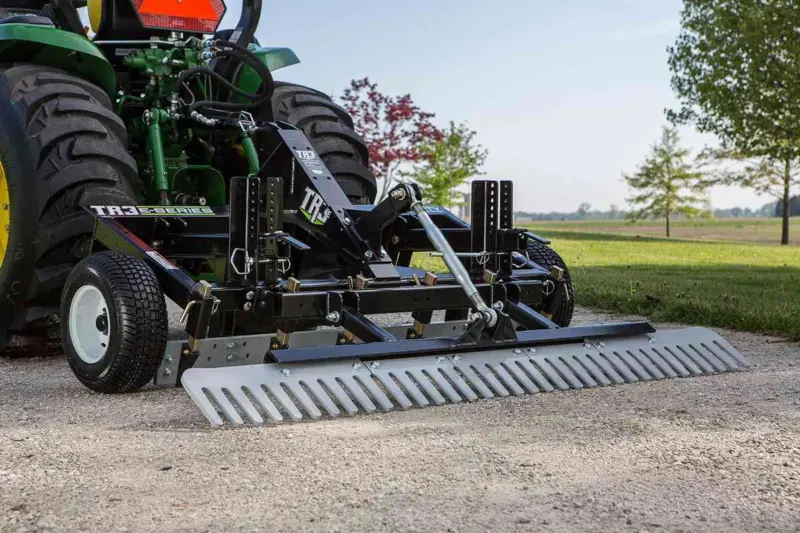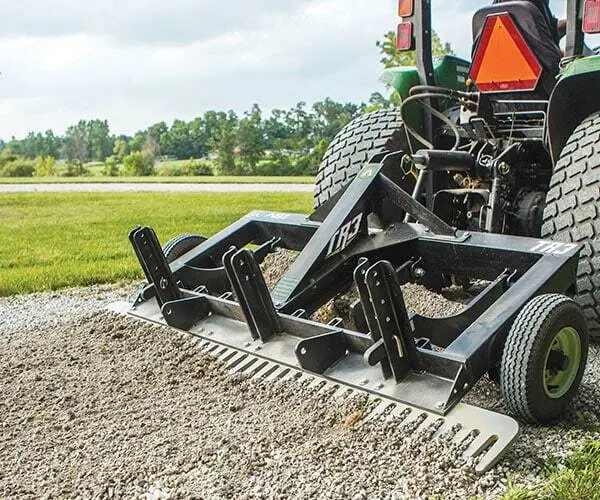
When you look at the wheels on the TR3 Rake and the TR3 E-Series, they appear similar at first glance. Both use a 16 inch wheel. Both use a five lug rim. Both include serviceable bearings and grease fittings.
But how they behave on the ground, and how they control the tool, comes down to two very different engineering approaches.
What A Stabilizing Wheel Actually Does
A stabilizing wheel is not a transport component. It is a depth control system.
As the attachment moves forward:
- The wheel sets a fixed frame height
- That height determines how deep ground engaging components can operate
- The frame follows terrain changes while maintaining that set depth limit
This means scarifiers, leveling blades, and grooming components cannot dig deeper than what the wheel allows. The wheel becomes the physical reference point for the entire tool.
In practice, that produces:
- More consistent grading depth
- Less operator dependency
- Fewer passes required to achieve a finished surface
- Reduced risk of over-cutting soft spots
TR3 vs TR3 E-Series Stabilizing Wheel Comparison
Feature | TR3 | TR3 E-Series |
Tire Type | Foam filled | Air filled |
Wheel Weight | 32 lbs | 22 lbs |
Diameter | 16 inches | 16 inches |
Lug Pattern | 5 lug | 5 lug |
Primary Use | Commercial and high-hour work | Residential and compact tractor use |
Wheel Block Orientation | Horizontal adjustment | Vertical adjustment |
Depth Control Method | Forward and backward position changes | Three position height settings |
Crown Control Method | Left/right offset wheel positioning | High/low wheel positioning |
Design Priority | Durability and continuous use | Simplicity and weight reduction |
Serviceability | Greaseable hubs, replaceable bearings | Greaseable hubs, replaceable bearings |
TR3 Stabilizing Wheel Design
The TR3 wheel system is built for commercial environments where uptime and durability matter more than weight savings.
Foam Filled Construction
Foam filling eliminates the risk of flats in the field. That matters when the machine is running long days in rough conditions where downtime is expensive.
The added weight also improves stability. At 32 pounds per wheel, the stabilizing system contributes to consistent frame control when working at scale.
This setup is designed for:
- Commercial landscaping crews
- Sports field maintenance
- High-hour daily operation
- Contractors working multiple properties per day
Horizontal Five Hole Wheel Block
The TR3 uses a horizontal adjustment system that moves the wheel forward and backward.
That adjustment impacts four functional areas:
- Depth control
Moving wheels forward lowers the frame and increases engagement depth - Connectivity
Allows compensation for variations in three point hitch geometry - Material flow behavior
Changes how material moves through the attachment - Crown control
Offsetting one wheel forward and one backward creates a controlled tilt that shapes gravel driveways
This system provides a wider range of adjustment because commercial work demands flexibility across different tractors and job conditions.
TR3 E-Series Stabilizing Wheel Design
The E-Series is designed specifically for compact and subcompact tractors where weight and simplicity matter more than maximum durability cycles.
Air Filled Construction
Air filled tires reduce overall weight and improve surface compliance.
At 22 pounds per wheel, the system is significantly lighter, which reduces strain on smaller tractors and improves balance during operation.
Air fill also has a functional advantage in loose materials like sand. The tire can conform slightly to surface variations, helping maintain consistent depth in arenas and softer soils.
Vertical Three Hole Wheel Block
Instead of moving forward and backward, the E-Series adjusts depth vertically.
- Bottom hole: standard operating depth
- Middle hole: increased depth
- Top hole: maximum aggressive engagement
This simplifies setup and reduces adjustment complexity for residential users.
Crown control is still possible by placing one wheel higher and the other lower, creating a controlled tilt in the frame.
Why Stabilizing Wheels Matter in Real Work
Across both models, stabilizing wheels solve the same core problem: controlling depth without relying on operator skill.
That produces three consistent outcomes:
1. Depth consistency
The tool cannot exceed the wheel set depth, regardless of terrain variation.
2. Repeatable results
Different operators achieve the same surface finish without re-training.
3. Reduced correction work
Less hand raking, less re-passing, fewer inconsistencies in final grade.
This becomes especially important in commercial or multi-operator environments where consistency matters more than individual technique.
Where Each System Performs Best
TR3 Strengths
- Commercial landscaping operations
- Heavy property maintenance
- Large acreage grading and finishing
- Multi-hour daily use environments
- Mixed tractor compatibility
TR3 E-Series Strengths
- Residential properties
- Horse arenas and footing maintenance
- Gravel driveway upkeep on compact tractors
- Small acreage landowners
- Light to moderate soil conditioning
Key Takeaway
The difference between the TR3 and TR3 E-Series stabilizing wheels is not just weight or tire type. It is the difference between commercial durability engineering and compact tractor optimization.
Both systems solve the same problem: controlling depth without relying on operator precision alone. They just solve it in different ways based on machine size and application.
That is why on ABI attachments, a tire is never just a tire.