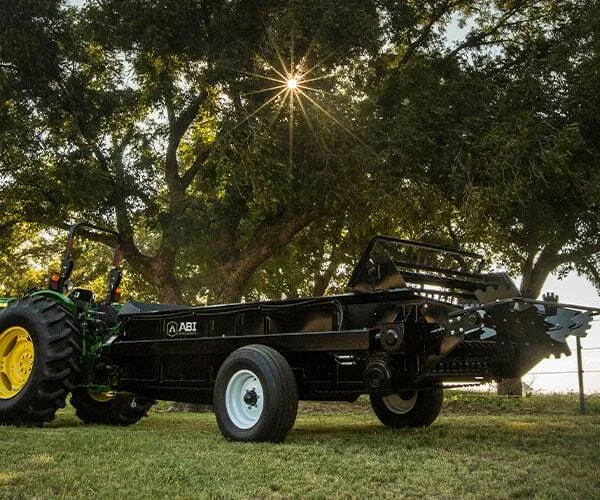
A Machine Built for Long-Term Farm Use
When ABI brought the 185 cubic foot PTO manure spreader out to Stoney Ridge Farmer’s property in the Blue Ridge foothills of North Carolina, it was his first time seeing the machine in action.
His reaction was not about features or specs. It was about durability.
He compared it to his existing spreader, which he estimated at 60 to 80 years old and still functioning. After using the ABI unit, he described it as a “hundred-year machine,” pointing to how overbuilt and solid it felt in the field.
That comparison matters in farming because equipment is not treated as short-cycle inventory. It is expected to survive constant loading, corrosive material, uneven terrain, and seasonal workload over decades.
The Land Context: Rebuilding a Tobacco-Depleted Property
The property being worked is a former tobacco plantation in the foothills of the Blue Ridge Mountains in North Carolina. Tobacco production is known for long-term soil depletion, especially in biological activity and organic matter.
The land condition at the start included:
- stripped topsoil biology from decades of cropping
- heavy brush regrowth over abandoned fields
- rocky and uneven ground conditions
- low organic matter and weak soil structure
The restoration process has followed a staged approach:
- timber harvesting and clearing
- stump removal and rough grading
- initial grass seeding with fertilizer support
- early pasture establishment
- transition into soil rebuilding with organic inputs
At the stage shown in the discussion, the focus has shifted toward rebuilding soil biology rather than just forcing grass growth.
Why Manure Matters in Soil Recovery
The key shift in approach is moving from chemical fertilizer to organic soil inputs.
Chemical fertilizer can push initial growth, especially on depleted land, but it does not rebuild the living structure of soil.
Manure contributes something different:
- organic carbon that feeds soil biology
- microbial populations that support nutrient cycling
- improved soil structure and aggregation
- better water retention and root development conditions
In practical terms, manure is not just feeding plants. It is rebuilding the environment plants grow in.
Grass does not thrive long term in soil that has no biological activity. It needs living soil, not just nutrients.
Why Small Acreage and Large Acreage Have the Same Soil Requirement
A key point from the field explanation is that soil biology does not change based on farm size.
Whether you are managing:
- five acres of pasture
- ten acres of mixed grazing land
- a 200 acre cattle operation
the soil still requires organic matter, microbial activity, and structure development.
The difference is not in what the soil needs. It is in how fast you can apply it.
ABI addresses that by scaling equipment from small ground drive spreaders up to large PTO-driven units like the 185 cubic foot model used on this property.
From Small Loads to Full-Scale Application
Before upgrading equipment, manure application was done with a very small spreader that held roughly two buckets of material.
That creates operational limits:
- frequent stopping to reload
- low coverage per cycle
- inefficient time use across large acreage
- uneven application timing across fields
Moving to a 185 cubic foot PTO spreader changes that dynamic significantly. Each load covers more ground, which means biological inputs can be applied at the correct time in the growing cycle instead of being delayed by equipment capacity.
That timing matters because soil biology responds to seasonal conditions. Missing a window can slow pasture establishment or reduce effectiveness of the input.
Ground-Level Performance Difference
In the field demonstration, the key difference observed was consistency and distribution.
A properly sized PTO spreader allows:
- even manure distribution across wide passes
- controlled application density
- reduced overlap waste
- better integration into existing soil surface
Instead of patchy application, the material is distributed in a way that supports uniform pasture development.
Equipment Philosophy: Longevity Over Replacement
The “100-year machine” comment reflects a broader mindset in agricultural equipment use.
On long-term land development projects, equipment value is measured by:
- lifespan under heavy use
- resistance to corrosion and fatigue
- ability to handle wet and uneven terrain
- consistency over repeated seasonal cycles
In that context, durability is not a feature. It is the core requirement.
Key Takeaway
The shift happening on this property is not just equipment-driven. It is soil-driven.
The move from chemical establishment to manure-based soil rebuilding reflects a long-term approach to pasture health.
In that context, the ABI manure spreader is not just a distribution tool. It is part of the system that rebuilds the foundation grass depends on.